Juliana Frink
Juliana Frink is a judo instructor living in Canon City, Colorado, and the ex-wife of Frank Frink. Her journey through the novel traces a path from a life of quiet desperation and casual violence to a decisive act of self-preservation and a final, unsettling revelation about the nature of reality itself. She is the character who most directly confronts the novel's central question: what is true, and what does it mean to believe?
Identity and Background
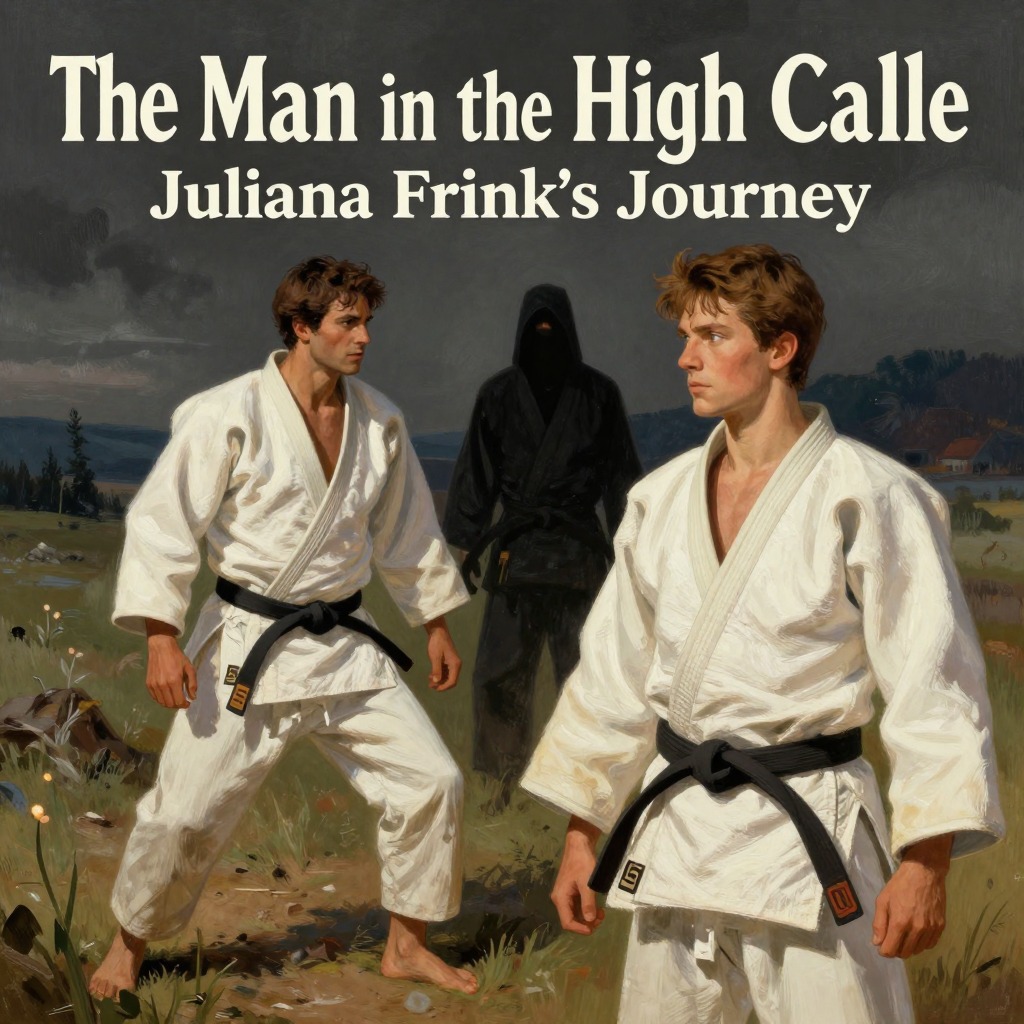
Juliana Frink is a woman shaped by loss and survival. She was married to Frank Frink, a Jew who changed his name from Frank Fink, and she divorced him a year before the novel's events. She has not seen him in months and does not even know where he lives. She works as a judo instructor, a skill she learned from a Japanese teacher named Minoru Ichoyasu in Seattle, a city she describes as having a long-established Japanese community. Her judo training gives her a physical confidence and a knowledge of how to kill, but it also reflects a deeper, more philosophical acceptance of mortality, which she says she "imbibed" from the Japanese along with the money-making judo. She is described as the best-looking woman Frank ever married, with soot-black eyebrows and hair, trace amounts of Spanish blood giving her pure color, and a "screwball expression" that drew strangers in. She is also marked by a deep, restless dissatisfaction, a feeling that she is always moving on, always seeking something she cannot name.
Life and Plot Trajectory
Juliana's life in Canon City is one of routine and quiet observation. She works at Ray's Gym, and her evenings are spent at Tasty Charley's Broiled Hamburgers, where she watches the Nazi rocket ships fly overhead. Her encounter with Joe Cinnadella, a truck driver who claims to be an Italian veteran of the North African campaign, breaks this routine. She is drawn to him, sensing something "special" and "deathly" about him. They begin a relationship, and he convinces her to drive to Denver with him, ostensibly for a shopping trip and a good time. In Denver, Joe buys her expensive clothes, including a blue Italian dress, and dyes his hair blond. It is then that Juliana realizes he is not a truck driver but an SD assassin sent to kill Hawthorne Abendsen, the author of The Grasshopper Lies Heavy. When he tries to force her to accompany him to Abendsen's house, she slashes his throat with a razor blade. She then drives alone to Cheyenne, Wyoming, to warn Abendsen.
Key Actions and Objectives
Juliana's primary objective shifts from a desire for escape and pleasure to a mission of warning and truth-telling. Her key action is the killing of Joe Cinnadella, a moment of violent self-assertion that she describes as a deliberate act: "I meant to." This act is not one of panic but of calculated self-preservation, born from her judo training and her deep-seated fear of the man. Her subsequent journey to Cheyenne is driven by a compulsion to warn Abendsen, a mission she believes is sanctioned by the I Ching, which she consults after the killing. The oracle tells her to "undertake something" and to "report to the prince," which she interprets as a command to go to Abendsen. She also seeks to understand the truth of Abendsen's novel, which she has been reading, and to confront him with what she believes it reveals.
Relationships and Conflict
Juliana's relationships are marked by conflict and a fundamental inability to connect. Her marriage to Frank Frink ended in divorce, and she still feels a lingering connection to him, even consulting the I Ching about him. Her relationship with Joe Cinnadella is a volatile mix of attraction and terror. She is drawn to his intensity and his hatred of life, but she is also deeply afraid of him. She recognizes that he is "killing himself with cynicism" and that he has "nothing to give his love to." The central conflict of her story is the physical and psychological struggle with Joe, which culminates in his death. Her final relationship is with Hawthorne Abendsen, whom she meets as a reader and a savior. She challenges him, demands the truth about his book, and ultimately forces him to confront the possibility that his fiction is, in fact, reality.
Change and Ending
Juliana undergoes a profound transformation over the course of the novel. She begins as a passive observer, a woman who "walks upright in consciousness of many pinched-nerve possibilities." She is cynical and world-weary, but also capable of great violence. The killing of Joe Cinnadella is a turning point, an act that she does not regret but that leaves her shaken. Her journey to Cheyenne is a pilgrimage of sorts, a search for meaning and truth. At the Abendsen house, she confronts the author with her interpretation of his book, insisting that it is not a work of fiction but a true account of a world where the Axis lost the war. She forces him to consult the I Ching, which confirms her belief. The novel ends with Juliana leaving the Abendsen house, walking alone into the night, having delivered her warning and her revelation. She is no longer the woman who was afraid; she is now the one who has seen the truth, even if it makes others angry.
Narrative Role and Evaluation
Juliana Frink serves as the novel's moral and epistemological center. She is the character who most directly acts on her convictions, who kills to protect another, and who seeks the truth with a relentless, almost supernatural intensity. Hawthorne Abendsen calls her a "daimon," a "little chthonic spirit that roams tirelessly over the face of the earth." She is the agent of revelation, the one who forces the novel's central question into the open. Her journey from a victim of circumstance to a decisive actor and truth-seeker provides a counterpoint to the political machinations and moral compromises of the other characters. She is the one who, in the end, understands that the oracle's message is not about the future but about the present, and that the truth, however terrible, must be faced.